IROS 2026 Accepted
MaskVLA: Visual Masking Against Trajectory Overfitting of Vision-Language-Action Model
1FNii, Shenzhen
2CUHK-Shenzhen
3Ising AI
4University of Glasgow
5Southeast University
 Paper
Paper
 Code
Code
Abstract
Reducing trajectory overfitting with view-balanced training.
Vision-Language-Action (VLA) models integrate vision-language understanding with executable robot actions, enabling end-to-end learning for robot control. However, when fine-tuned on limited manipulation datasets, existing models can overfit to demonstration trajectories and rely too heavily on the primary camera view.
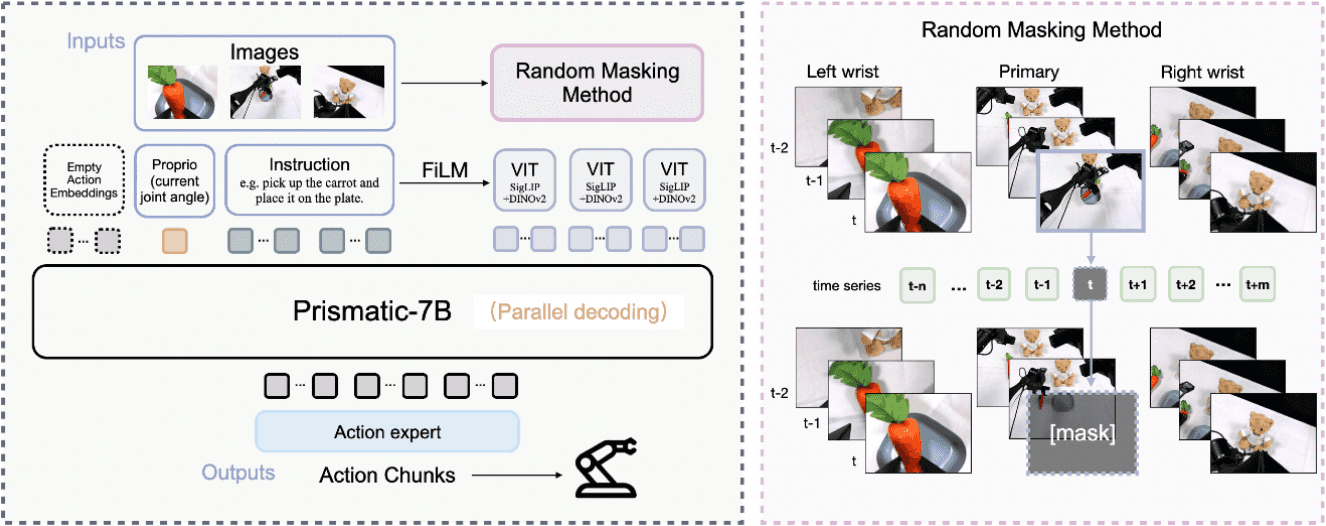
MaskVLA introduces a simple masking-based fine-tuning strategy: randomly mask a small portion of the primary camera input during training so the policy learns to use wrist-camera information more effectively. On RoboTwin2.0, MaskVLA improves average success by 23.2% over π0 and 16.8% over OpenVLA-OFT, with additional gains on real-world ALOHA tasks.
Method
Random masking on the primary camera view.
The primary view gives global scene context, while wrist cameras provide close-range evidence during occlusion and contact. MaskVLA explicitly discourages primary-view shortcuts during fine-tuning.
Diagnose overfitting
Grad-CAM analysis shows baseline attention drifting toward local texture cues and primary-view bias.
Mask the shortcut
Primary-camera masking forces the policy to learn from all available visual streams.
Recover robustness
At inference time the mask is disabled, letting the model use full multi-view observations.
Results
Consistent gains in simulation and on ALOHA robots.
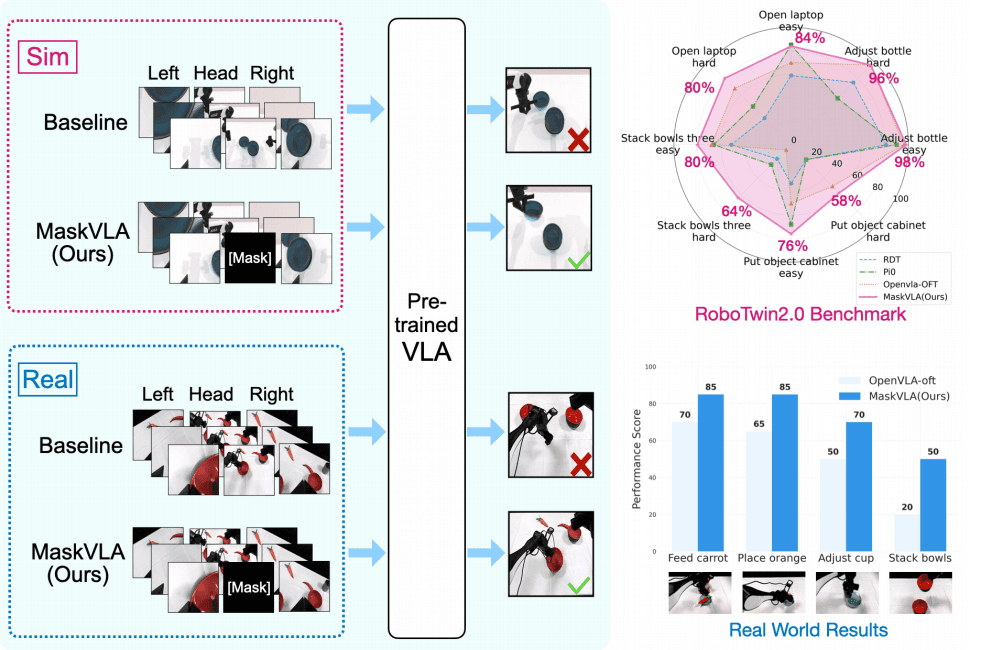
RoboTwin2.0 benchmark
MaskVLA achieves the best average performance across four bimanual manipulation tasks. In hard mode, it reaches 75.0% average success, a 20.0-point gain over OpenVLA-OFT.
- Best performance on 6 of 8 simulation subtasks.
- Large gains on position-generalization tasks such as Stack bowls three.
- MaskVLA-main-10% is the strongest ablation setting, averaging 74.0% in hard mode.
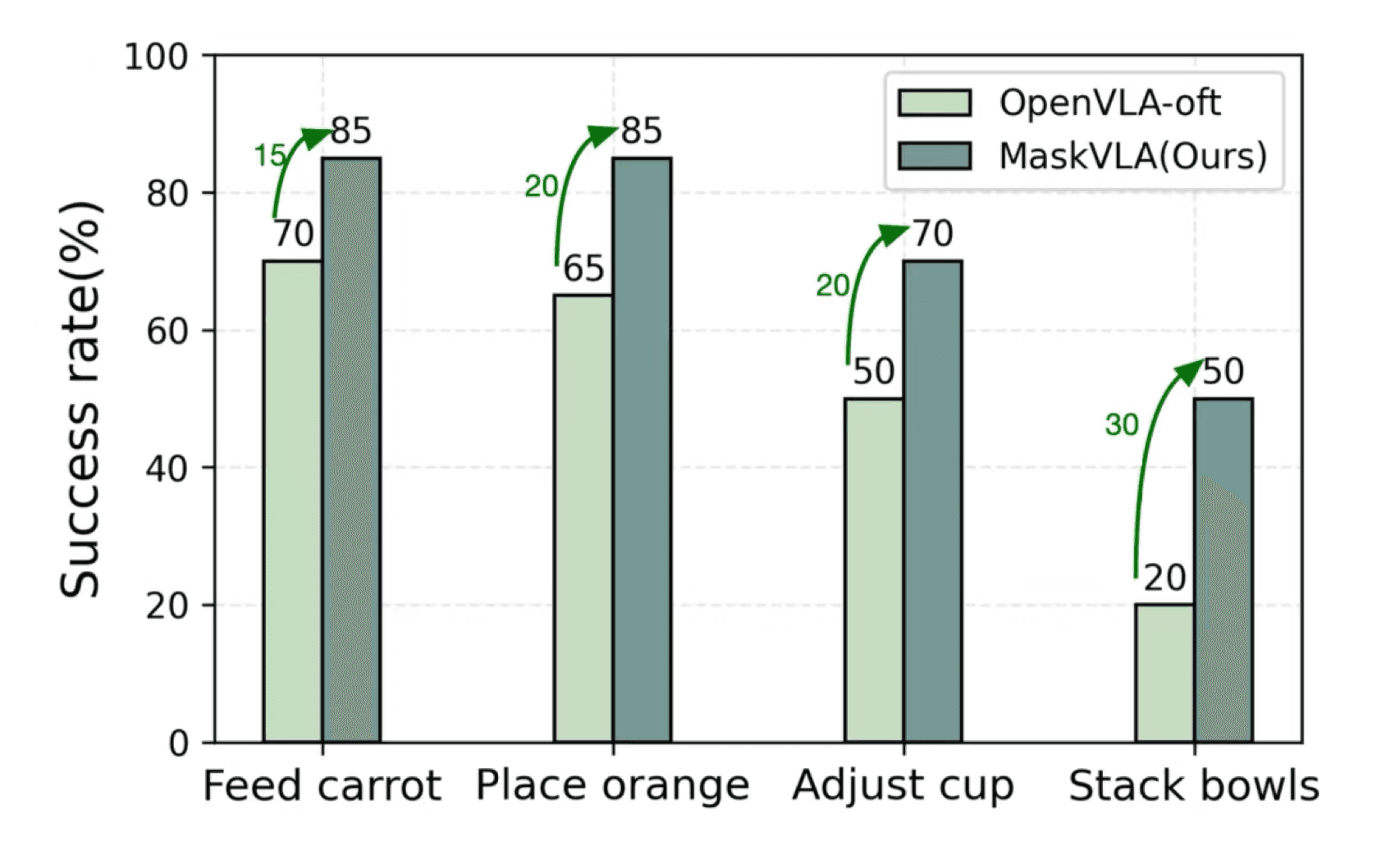
Real-world ALOHA evaluation
On the Airbot Mobile ALOHA platform, MaskVLA improves over OpenVLA-OFT across all four real-world tasks, including 85.0% success on Feed carrot and Place orange and 70.0% on Adjust cups.
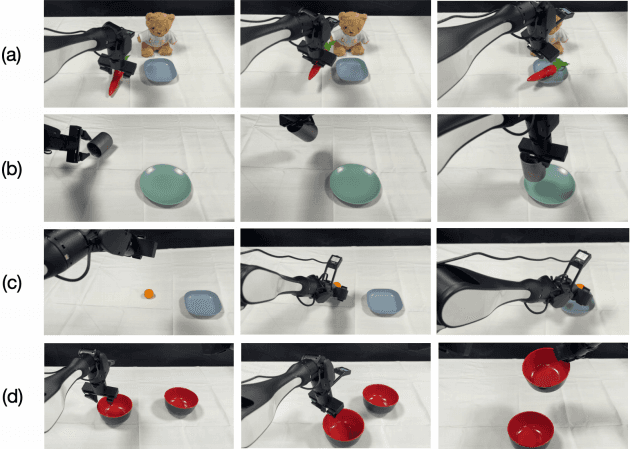
Videos
Qualitative rollouts.
Simulation comparisons use randomized hard settings. Real-world videos show successful ALOHA rollouts.
Simulation: MaskVLA success vs. baseline failure
Adjust Bottle
MaskVLA
Baseline
Open Laptop
MaskVLA
Baseline
Put Object Cabinet
MaskVLA
Baseline
Stack Bowls Three
MaskVLA
Baseline
Real-world ALOHA rollouts
Feed Carrot
Adjust Cups
Place Orange
Stack Bowls
Citation
@inproceedings{jiang2026maskvla,
  title  = {MaskVLA: Visual Masking Against Trajectory Overfitting of Vision-Language-Action Model},
  author = {Jiang, Yuxuan and Huang, Jiaying and Wang, Ge and Yan, Shenhao and Yang, Jiahao and Yao, Chengsi and Liu, Qi and Zhao, Qing and Cui, Shuguang and Zhao, Yiming and Han, Yatong and Li, Zhen},
  booktitle = {IEEE/RSJ International Conference on Intelligent Robots and Systems (IROS)},
  year = {2026}
}